

A practical guide to licensing, payments, bonuses and safeguards—and to the limits of what a UKGC licence can guarantee.
What a UK Casino Licence Actually Tells You
When I first started looking for a safe online casino in the UK, I treated a polished website and a familiar logo as reassuring signs. They are not the same thing as permission to operate. The basic question is whether the casino holds a UK Gambling Commission (UKGC) licence for serving players in Great Britain.
The UKGC regulates gambling operators that offer services to British players. For a casino, a current UKGC licence is not an optional badge or a mark of customer-service quality: it is a legal requirement to operate for UK players. A business based overseas does not escape that requirement simply because its servers or head office are elsewhere. If it is selling real-money casino gambling into the British market, it needs the relevant UKGC licence.
That is the regulatory baseline. It tells you the operator is within the UK’s gambling rules and subject to the regulator’s oversight. It does not tell you that you will win, that every withdrawal will be effortless, or that a bad experience is impossible. I learned to be wary of the word “safe” when it is used as if it were a promise. A licence is meaningful, but it is not a guarantee against losing money or every dispute.
A UKGC licence also comes with requirements that affect how play is offered. Licensed operators must provide ways to set deposit limits, take a time-out and exclude yourself through GamStop. New customers must be prompted to set a financial limit before their first deposit, with account-level controls available to change it. These are practical protections, not a prediction about whether a particular person will gamble within their own limits.
Online casino Malta MGA licence in the UK: what to check
Age checks are another part of the framework. On licensed platforms, age verification is required before a person can access gambling-related content, including free game demos. An operator must also verify a customer’s age before allowing a deposit into a gambling account. That can feel like friction when you want to get started, but it is there to prevent underage access, not to make a site look more official.
It helps to separate the regulator’s role from the casino’s marketing. “Trusted” is a claim a company can put on a page; a UKGC licence is a regulatory status. The licence makes the operator accountable to the UK system, while the advertising language is just language. I used to blur those together. Bad shortcut.
The Gambling Act 2005 governs gambling in England, Wales and Scotland, and operators offering real-money gambling to customers there need a Gambling Commission licence. Northern Ireland has a separate legal framework, so it is worth being precise about what “UK” means when reading general claims. For British players, though, the practical point remains: an online casino serving them legally must hold the appropriate UKGC licence.
VPN-Friendly Casinos in the UK: What to Know
This is why a UKGC licence matters when you are deciding whether a casino belongs in the regulated market. It sets the legal threshold and attaches specific player-protection obligations to the operator. It is not a personal endorsement from the regulator, nor does it remove the need to make your own decisions about whether to play.
One more thing I keep in mind: if you register through a partner casino linked from this site, the site may receive a commission. That relationship does not change what a UKGC licence means, but it is useful context when you see recommendations or promotional wording. I prefer to know who may benefit before I take a claim at face value.
How to Check a Casino’s Licence Before You Deposit
A licence badge is easy to place on a page. The useful question is whether the details behind it match the casino you are actually using. I treat the badge as a starting point, not proof.
Verify a Licence
Step 1: Find the number
Locate the operator’s UKGC licence number on the casino’s website.
Step 2: Search the register
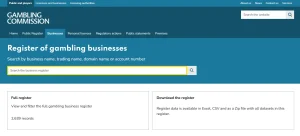
Open the Gambling Commission’s public register and search for that number.
Step 3: Match the details
Confirm that the website domain, trading name, and legal business exactly match the entry in the register.
Find the operator’s UKGC licence number and open the Gambling Commission’s public register. The register link should sit beside the licence information, so you can check the claim without hunting around the site. Search the number there and make sure the entry is current and relates to the operator offering gambling to Great Britain customers.
Then compare the details, not just the name at the top of the page:
- Website domain: Check that the exact address you plan to use appears in the register. A similar-looking address or a different domain is not a match.
- Trading name: The consumer-facing casino name may differ from the name of the company behind it. Look for the brand or trading name in the register.
- Legal business: Confirm that the registered business is the one identified in the casino’s terms or company information.
- Licence number: Check that the number on the casino’s page matches the entry, rather than assuming a copied badge belongs to that site.
I once saw a familiar brand name and nearly stopped there. That is the sort of shortcut that leaves the important part unchecked. A valid entry for one business or domain does not, by itself, establish that another site using a similar name is covered.
If the number is missing, the register entry cannot be found, or the domain and business details do not line up, do not deposit on the strength of a generic “UK licensed” claim. Contact the operator for clarification and verify any new details against the Commission’s register before deciding what to do. If you cannot establish a clear match, walk away. Better than guessing.
Age checks matter too: licensed platforms must verify your age before letting you access gambling-related content, including free demos, and before allowing a deposit. New customers must also be prompted to set a financial limit before their first deposit, with account-level limit controls available. These are practical signs to look for, but they do not replace the register check.
I use the same rule when someone asks how to choose a safe online casino: verify the operator’s current UKGC licence against the exact site, trading name and legal business. “Trusted” is a label. A matching register entry is something you can check.
Prestige may receive a commission if you register with a partner casino. That does not change the checks above.
Safe Casino Sites: Look Past the ‘Trusted’ Label
“Trusted” is an easy word to print beside a casino logo. It tells you nothing by itself. When I assess a site, I look for evidence I can check: a current UKGC licence that matches the business and the website, clear account controls, and protection tools that are genuinely available once you sign in. A polished design or a reassuring badge is not a substitute.
Merkur casino online UK: slots, licences and offers
Start with the licence details, not the sales copy. The operator should identify the legal business behind the casino and give information that lets you match it to the UK Gambling Commission’s public register. Check the licence number, the exact website domain, the trading name and the legal business against the register, rather than assuming a badge or general claim proves anything. The Commission’s public register is the place to verify the entry. A mismatch, missing details or a licence entry you cannot identify is a reason to pause before creating an account.
This is more than paperwork. A casino offering real-money play to people in Great Britain needs a UKGC licence to operate legally here. If you cannot identify the operator’s UKGC entry, do not treat the site as a safe UK casino simply because it accepts British customers or displays another regulator’s logo. The protections attached to UKGC-regulated play may not apply.
Check what the account actually lets you do
A licensed casino must provide tools to help you control your gambling. Look for deposit limits, time-outs and self-exclusion through GamStop. I would check whether these controls are easy to find in the account area, not just mentioned in a responsible-gambling page. If you have to hunt through menus to locate a limit setting, that is useful information about how the site is designed, even if the tool is technically present.
Do
- Set a financial limit before your first deposit
- Check for easy-to-find account controls
- Verify UKGC status before using GamStop
Don’t
- Hunt through complex menus for limit settings
- Rely on promotional wording for protection
- Assume GamStop applies to non-UKGC sites
New customers must be prompted to set a financial limit before making their first deposit, and account-level limit controls must remain accessible. That gives you a chance to decide what you can afford before money is in play, rather than trying to make the decision after a session has started. It is worth checking the controls before you deposit. A sensible limit is only useful if you understand how to set it and can find it again.
Self-exclusion is a more serious step than taking a short break. UKGC-licensed operators must offer self-exclusion through GamStop. If you use that service, do not rely on a site’s own promotional wording to tell you whether it is covered; check that the operator has an identifiable UKGC entry. Without one, you should not assume GamStop protection applies.
Age checks matter too. Licensed platforms must verify your age before you can access gambling-related content, including free demos, and must verify that you are old enough before allowing a deposit. A free game is still gambling-related content in this context; it is not a reason to wave through an age gate. If a site lets you reach casino content without the required age verification, that is not a reassuring shortcut.
Judge the safeguards, not the branding
A secure-looking homepage can still leave basic questions unanswered. Read the site’s terms and account information closely enough to understand who operates it, what controls are available and where to go if something goes wrong. Do not confuse a neat interface with evidence of protection. I have made that mistake: a familiar layout can make a site feel established before I have checked who is actually behind it.
Most Trustworthy Online Casinos in the UK: What to Check
If there is no identifiable UKGC licence entry, do not assume that UKGC-regulated alternative dispute resolution or UK-specific consumer-funds protections apply. Those are not details to discover only after a payment or complaint becomes difficult. Take the time to establish the operator’s regulatory status first. No clear entry, no easy assumption.
Also notice whether the site makes safer-gambling tools visible without turning them into another sales pitch. A reminder about limits is different from a banner promising that you can “play responsibly” while pushing you towards another deposit. I look for practical controls and plain explanations, not slogans. That is a small distinction, but it changes what the page is asking you to do.
No checklist can make gambling risk-free. A UKGC licence and its required safeguards establish a regulatory framework; they do not promise that you will win, prevent every poor decision or make a session harmless. If gambling stops feeling like entertainment, use the available controls and seek help from services such as GamCare or BeGambleAware.
This page may receive a commission if you register at a partner casino. That does not change what you should verify for yourself: the current UKGC entry, the account controls and whether the site gives you a clear route to use them. Labels are cheap. Check the working parts.
Real-Money Play, Bonuses and the Small Print
Depositing money and accepting an incentive are separate decisions. You can fund an account and play with your own balance without taking a welcome offer; if you accept a bonus, its conditions may affect how much you can withdraw and what you can play while it is active. I’ve learned not to treat the headline amount as the useful part. The terms are.
Attention: A "free" no deposit bonus may have wagering requirements that make it difficult to turn winnings into withdrawable cash.
A no deposit bonus is still an incentive, even if you do not pay in first. Check what the offer actually lets you do, which games count towards its wagering requirement, and what happens to the bonus or any winnings if you do not meet the conditions. “Free” can describe how the credit arrives. It does not tell you whether it is simple to turn into withdrawable cash.
Read the wagering requirement as a calculation
A wagering requirement tells you how much qualifying play is needed before bonus-related funds can be withdrawn. The figure may be calculated against the bonus alone or against the deposit and bonus together. Those are different bases, so do not rely on the multiplier by itself: identify the amount it applies to, then work out the required turnover.
For instance, if the terms use the bonus alone, the deposit may not be part of that calculation. If they use the combined deposit and bonus, it is. The wording should make the basis clear; if it does not, ask the operator before opting in rather than assuming the smaller total.
For incentives offered in Great Britain, the wagering requirement must not exceed 10x. A single incentive must also be limited to one type of gambling product: it cannot bundle betting, casino, bingo or lottery play together. That matters when an offer looks flexible but its terms send you between different products.
Anjouan Casino Licence UK: What Players Should Know
Check which games count
A game can be available on the site without contributing fully, or at all, to bonus wagering. The terms should say which games qualify and whether a game’s contribution changes the calculation. A specialist review reports slots contributing 100% of each pound staked and table games contributing 5% to 10%; treat that as a reported comparison, not a promise about every offer. Read the specific promotion’s terms.
Here is the practical difference: if a game contributes only part of your stake, the qualifying turnover builds more slowly than the amount you have actually wagered. A game that feels like an easy way to clear a requirement may therefore do less for it than you expect. Don’t confuse time spent playing with progress towards the requirement.
Also look for conditions on the stake, eligible games, expiry, withdrawal and what happens if you cancel the bonus. The terms should explain these points. If they are hard to find or unclear, skipping the incentive is a perfectly sensible choice. No bonus is owed to you.
Decide before you click
I used to accept offers first and read the terms after. That is the wrong order. Decide whether you want to play with your own deposited balance or take on the extra conditions of an incentive, then make sure the offer matches that choice. A safe real-money casino experience is not made safer by a large bonus; the useful question is whether you understand the conditions before they shape your play.
If you register through a partner casino link on this site, we may receive a commission. That does not change the need to read the promotion’s terms yourself. Keep the decision boring: understand the calculation, check which play qualifies, and decline if the rules do not suit you.
Casino Licensing and Safety in the UK
Reliable Does Not Mean Risk-Free: Funds and Affordability Checks
“Player funds are segregated” sounds reassuring, and it is a meaningful safeguard. UKGC-licensed operators must keep players’ funds apart from the money used to run the business. But separation is not the same as a promise that every balance is instantly available in every circumstance. It tells you something about how the operator is required to handle funds; it does not make gambling risk-free or turn a balance on screen into a guaranteed payout.
I used to treat reassuring phrases as if they settled the whole question. They don’t. A financial safeguard is one part of the picture, not a reason to deposit more than you can afford to lose. Think of the money you put into an account as available for play only when you are comfortable with the risk of losing it. A licence and rules around handling funds matter, but they cannot remove the basic uncertainty of gambling.
Affordability checks can also affect how an account works. UKGC-licensed platforms may be required to ask some customers for evidence of income when their spending meets criteria linked to thresholds that are not disclosed in advance. That does not mean every player will be asked at the same point, or that you can predict exactly when a check will happen. It does mean a request for information can arise during play, even if you were not expecting one.
That can feel intrusive, especially if you thought depositing was the only financial step involved. I’d rather know the possibility exists than be caught off guard. If a platform asks for income verification, treat it as part of its affordability process, not as a sign that the site has assessed your personal finances in full or concluded that further gambling is safe for you.
Curacao Casino Licence in the UK: What It Means
It is also worth separating an affordability check from a personal budget. The operator’s process does not know every commitment you have or what you need the money for. Set your own limit before you start and stick to it; do not raise it just because a platform allows you to continue, or because you have already lost money. Chasing a loss is still chasing a loss.
When comparing claims about reliable online casinos in the UK, look beyond the reassuring wording. Segregation and affordability checks are safeguards with defined purposes. Neither is a guarantee against losses, a promise that every withdrawal will be immediate, or a recommendation to keep playing. Safe and reliable should never mean “nothing can go wrong”.
A sensible choice is one where you understand what the protection does and where its limits are. If the wording is vague, or a review calls a casino “safe” without explaining what that means, don’t let the label make the decision for you. I’ve made that mistake. The label isn’t the safeguard.
This site may receive a commission if you register with a partner casino. That does not change what segregation or affordability checks can establish, so keep your own judgement in the loop.
Payments, Withdrawals and the Verification That Holds Them Up
I used to treat the withdrawal button as the moment a casino might start asking questions. That is the wrong point to leave everything until. Licensed operators have to verify your identity before they process a withdrawal, so an account that looks ready to play may still need documents before it can pay out.
Verification Documents
- Government-issued photo ID (passport or driving licence)
- Proof of address (utility bill or bank statement dated within 3 months)
- Confirmation of payment method ownership
Send your documents as soon as you have created the account, before depositing. The standard check asks for government-issued photo ID, such as a passport or driving licence, plus proof of address. A utility bill or bank statement can serve, provided it is dated within the previous three months. Depending on the payment method, the operator may also ask you to confirm that you own it.
Use details that match the account you opened. If your name or address differs between the account and a document, expect the operator to need clarification rather than assume the check is complete. Follow the instructions on the account and send clear, legible copies; a cropped or unreadable image can turn a simple request into another round of messages. Keep an eye on the account inbox as well as your email, because a request can sit unnoticed while you wait for a payout.
Age checks are part of the same process, not a box to wave away. Licensed platforms must verify age before allowing access to gambling-related content, including free demos, and before letting a customer deposit. That means free spins or a demo mode do not make age requirements disappear.
For a bank transfer, allow for the time it takes after the operator has completed its own checks and processing. A specialist review reported bank-transfer times of 3–5 banking days across the brands it examined; treat that as a reported comparison, not a promise for every casino or payment. The operator’s processing time and the bank’s handling are separate parts of the wait. If the account is still under review, the transfer clock may not yet be the only thing holding things up.
Gibraltar Casino Licence and UK Regulation Explained
This is why “fast payouts” can be a slippery label. A payment method may have a stated transfer window, but it does not bypass identity checks. Before you deposit, look at the casino’s withdrawal instructions: which documents it accepts, where to upload them, and whether it may request payment-method ownership confirmation. Then complete verification early and keep a record of what you sent.
I would rather spend a few minutes on that paperwork before playing than discover the requirement when I am waiting for money. It is not glamorous. It is practical.
Prestige may receive a commission if you register with a partner casino.
Casino Games Have Rules Too: Autoplay, Spin Speed and Stakes
A slot can look calm on screen and still be built to keep you moving. In Great Britain, rules now limit some of that pace. They do not make every game harmless, or remove the need to decide what you can afford to lose.
Autoplay is not available on UKGC-licensed online slots: it was removed in 2021. You have to start each spin yourself. There must also be at least 2.5 seconds between spins, a pause intended to slow play and make sessions less intense. It is not a long break, but it does interrupt the old rhythm of setting a slot to run while your attention wanders elsewhere.
That matters more than I expected. When I played on autopilot, I noticed the balance only after a run of spins. Having to press again makes the action more visible, though it does not change the odds or guarantee that you will stop when you planned to. A pause is not a safety net.
UKGC-licensed online slots must have at least 2.5 seconds between spins and do not allow autoplay.
The stake limit is not the same as a safe stake
For online slots, the maximum stake per game cycle is £5 for adults aged 25 and over, and £2 for players aged 18 to 24. The £5 limit for all adults took effect on 9 April 2025. These are caps, not recommendations. A smaller stake can still add up across a session, and a maximum permitted stake is not a sensible target just because the game allows it.
You may see broader claims about casino bet sizes. One specialist review reported a minimum stake of £0.10 and bets as high as £100 per round at the casinos it considered. That is a report about those reviewed casinos, not a standard applying across Britain; it also should not be confused with the specific online-slot stake cap.
A named slot such as Book of Dead does not get a different rule because it is familiar or popular. The relevant limits concern the way online slots operate, rather than a game’s theme or how polished its app looks.
Age checks matter before play as well. Licensed platforms must verify your age before you can access gambling-related content, including free demos, and before they let you deposit. So a demo is not a loophole for underage access.
Non-UK Casinos: What a UKGC Licence Means
When I use a casino app, I try to treat the controls as part of the game’s design, not proof that the app itself is “safe”. A forced pause can slow the sequence; it cannot set your personal limit for you or make gambling risk-free. The useful question is whether the rules are clear and whether you can stick to your own stopping point. The spin still costs money.
Licensed, Bitcoin-Friendly and Outside the UKGC: Know the Difference
A foreign gambling licence can tell you that an operator is overseen somewhere; it does not make that casino UKGC-licensed. Remote operators serving customers in Great Britain need the relevant UKGC licence, wherever the business is based. So if you are weighing a Bitcoin casino against licensed online casinos in the UK, don’t treat a badge from another jurisdiction as an equivalent form of cover.
The difference matters when something goes wrong. Offshore licences can come with less player protection than oversight from the UKGC or the Malta Gaming Authority, and non-GamStop casinos sit outside UK dispute-resolution channels. An operator based abroad is also not required to connect to GamStop. Without an identifiable UKGC entry, don’t assume GamStop self-exclusion applies, that you can use UKGC-regulated alternative dispute resolution, or that UK-specific consumer-funds protections cover your balance.
Offshore Casino Sites: What UK Players Should Know
That is a substantial trade-off, not a technicality. I’ve learned not to read “internationally licensed” as “protected in the same way”; it may simply mean another regulator has a role. If a site’s status is unclear, don’t let a Bitcoin payment option or a polished live casino lobby settle the question for you. A payment method says nothing about the regulator responsible for the operator.
Crypto withdrawal timing can also sound more certain in advertising than it is. A specialist review reports that, after an operator has processed a withdrawal, the on-chain transfer may take 10–30 minutes to settle. That describes the transfer stage, not the time spent waiting for the casino to approve or release it. Those are separate steps. Worth keeping straight.
Bitcoin can offer a different way to move funds, but it doesn’t create a UK dispute route or make an offshore operator subject to UKGC rules. Nor does the phrase “safe Bitcoin casino” tell you what recourse you have if an account is restricted or a payment is disputed. Check what regulator, if any, is actually responsible and what complaint route is available before depositing.
For a UK-facing operator, the relevant licence is the UKGC one; a foreign licence alone does not replace it. If there is no identifiable UKGC licence entry, treat claims about UK protections with caution rather than assuming they apply. Our site may receive a commission if you register with a partner casino through a link here. That commercial relationship is not a safety endorsement.
‘Best’ Is Personal: Decide What You Need Before You Play
Choosing a safe online casino means checking the details that matter to you, including how quickly payouts are listed to arrive. Use this page as a starting point and review each operator’s terms before deciding.
1. Chanze
Payout speed: 1-3 business days Chanze lists a payout speed of 1–3 business days, giving you a stated timeframe to consider.
2. EvoSpin
Payout speed: 1-3 business days EvoSpin lists payouts as taking 1–3 business days, which gives you a clear timing detail to check against its terms.
3. Zombillion
Payout speed: 1-3 business days Zombillion’s listed payout speed is 1–3 business days. You can use that timeframe as one factor when reviewing the operator.
4. SpinFormula
Payout speed: 1-3 business days SpinFormula lists a payout timeframe of 1–3 business days, useful to know if withdrawal timing matters to you.
5. Amunbet
Payout speed: 1-3 business days Amunbet lists payouts at 1–3 business days. Check its terms for any further details relevant to your withdrawal.
6. x3bet
Payout speed: 1-3 business days x3bet lists a payout speed of 1–3 business days, giving you a stated timeframe to bear in mind.
7. Revery Play
Payout speed: 1-3 business days Revery Play lists payouts as taking 1–3 business days. You may want to review its terms for additional withdrawal information.
8. WinBeast
Payout speed: 1-3 business days WinBeast’s listed payout speed is 1–3 business days, a useful timing detail if you are considering a withdrawal.
9. SlotoSport
Payout speed: 1-3 business days SlotoSport lists a payout timeframe of 1–3 business days. You can consider this alongside the operator’s terms.
10. NightWin
Payout speed: 1-3 business days NightWin lists payouts at 1–3 business days, providing you with a stated timeframe to review.
There isn’t one best safe online casino for everyone. I’ve made the mistake of treating a polished homepage as a recommendation; it told me nothing about whether the site’s controls suited the way I actually played. Decide what matters to you before a welcome offer or flashy game makes the choice for you.
Start with safeguards you would genuinely use. UKGC-licensed operators must offer deposit limits, time-outs and self-exclusion through GamStop. New customers must be prompted to set a financial limit before their first deposit, with account-level limit controls available afterwards. If a break from gambling is something you may need, consider whether those tools fit your needs before you register. They are not just menu items.
Think about your own boundaries, too. Would you rather set a limit before depositing, or do you tend to make that decision after a losing session? I’ve learnt that “I’ll sort it later” is not much of a plan. A control you can find and use matters more than a reassuring slogan.
Also consider the basics that affect your experience: whether you understand the terms of an offer, whether the games and payment options suit you, and whether you are comfortable with the checks involved. There is no universal winner, and a site that suits someone else may not suit you. Take time to choose; you do not have to register just because a promotion is in front of you.
Age verification is required before accessing gambling-related content on licensed platforms, including free demos, and operators must confirm your age before allowing a deposit. If you register through a partner link on this site, we may receive a commission. That does not make a casino the right choice for you. Decide by the safeguards and conditions you value, not by a “best” label.
Offshore Casinos for UK Players: What to Check
Secure Deposits: The Credit-Card Rule to Check
When I’m checking whether a deposit method is genuinely suitable for gambling, I look at the source of the money, not just the logo on the payment screen. In Great Britain, licensed operators have been barred from taking credit-card payments for gambling since April 2020. That includes a route where a money service business sits between the card and the gambling account: changing the route does not make credit-card funding acceptable.
The point is to stop people gambling with borrowed money. A card option appearing on a cashier page is not, by itself, proof that it can be used for a casino deposit. The restriction also covers digital wallets if they allow credit-card funds to be spent on gambling. So if a wallet is linked to a credit card, check how that payment will be treated before you confirm it.
I used to see a familiar payment logo and assume the whole transaction was straightforward. That was lazy checking. A secure deposit depends on the funding route as well as the site’s appearance; a padlock or polished checkout cannot tell you whether the underlying payment method complies with the rule.
If you are asked to route a credit-card payment through another service, pause rather than treating it as a clever workaround. For gambling with a UK-licensed operator, credit-card funding is not an allowed deposit route, whether it is presented directly or passed through a money service business. Keep the payment method clear and use one that does not rely on credit-card funds.
That is a narrow rule, but an important one. No workaround.
Is it safe to play at online casinos in the UK?
A current UK Gambling Commission (UKGC) licence means the casino is operating within the rules for serving players in Great Britain and must provide protections such as deposit limits, time-outs and GamStop self-exclusion. It does not guarantee winnings or prevent every dispute, so check the operator and exact website domain on the Commission’s public register before depositing.
What are the differences between UK-licensed and non-UK-regulated online casinos?
UKGC-licensed casinos must follow UK requirements, including offering deposit limits, time-outs and GamStop self-exclusion, and they cannot accept credit-card deposits. Offshore-licensed casinos are outside that UKGC framework: they are not required to connect to GamStop, offer the same level of protection or use UK dispute-resolution channels.
How do I know which new non GamStop casinos are trustworthy?
Check which regulator licenses the operator and whether the licence details match the casino’s business and exact website domain; look for a working link to the regulator’s official register. An offshore licence does not provide the same protections as a UKGC licence, and non-GamStop casinos are outside UK dispute-resolution channels.
What determines how an online casino bonus works in practice?
Check whether the wagering requirement applies to the bonus alone or to the deposit and bonus combined, and which games count towards it. Slots typically contribute 100% of your stake, while table games contribute 5% to 10%; bonus terms may also cap eligible bets at £5 per spin.
What exactly are non GamStop casinos and are they legal in the UK?
Non-GamStop casinos are operators that are not connected to the UK’s GamStop self-exclusion system, typically because they operate under an offshore licence. A casino serving players in Great Britain must hold a UKGC licence to operate legally there; an offshore licence alone does not meet that requirement.
What responsible gambling tools can I use?
At a UKGC-licensed casino, you can use deposit limits, time-outs and GamStop self-exclusion. Non-GamStop casinos are not required to connect to GamStop, so that self-exclusion system may not block access to them.
Material created by the team Prestige